
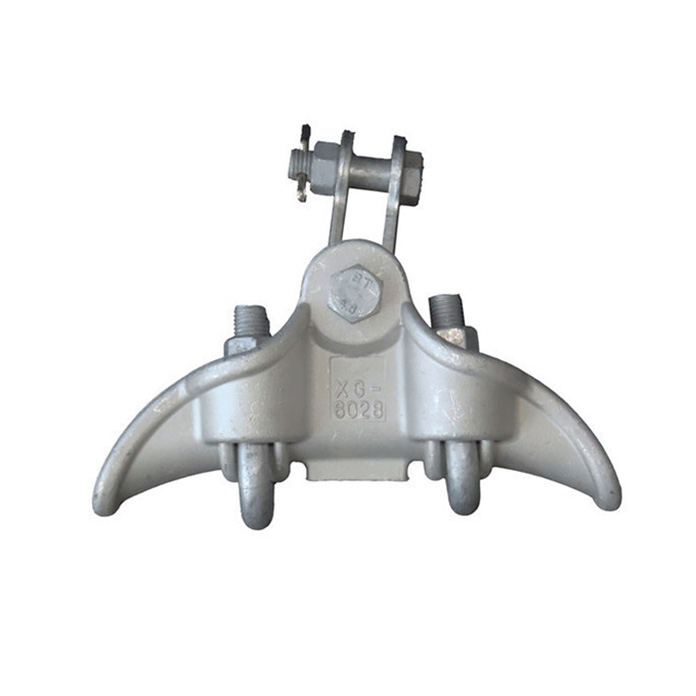
tension clamp
Description: Tension clamp is one of the crucial fittings in overhead transmission lines and distribution systems, and belongs to the fixed type of clamp. Its core function is to firmly anchor wires or lightning protection wires at both ends of the tension section of ...
Mobile:+86 13716380533
Email:Charlestools086@hotmail.com
Product Description:
Tension clamp is one of the crucial fittings in overhead transmission lines and distribution systems, and belongs to the fixed type of clamp. Its core function is to firmly anchor wires or lightning protection wires at both ends of the tension section of the line (such as towers, corner towers, terminal towers), bear all the tension of the wires, and transmit it to the tower structure, while protecting good electrical connectivity.
1、 Core functions and importance
The tension clamp is not just a connector, it plays a dual role as an "anchor" and "bridge" in the power grid:
Mechanical anchoring: It can withstand and transmit all the working tension of the wire (or lightning protection wire) and the unbalanced tension under fault conditions, and is a key protection for the mechanical strength of the line. Without it, the wires cannot be fixed at the terminals and corners.
Electrical connectivity: Confirm that the current flows smoothly from the wire through the clamp to the subsequent equipment (such as jumpers, equipment clamps), requiring excellent conductivity and low contact resistance to avoid overheating.
Good performance: Its excellence directly affects whether the entire line can operate safely under loads such as wind, ice, and temperature differences, preventing malignant accidents such as loose or broken wires.
2、 Main types, structures, and working principles
According to the installation method, applicable wires, and structural characteristics, tension clamps are mainly divided into the following three categories:
1. Bolt type tension clamp (NLD type)
Structure: Made of malleable cast iron or aluminum alloy, the main components include the hull (trunking), pressure plate, and U-bolt. Use the pressure generated by the bolt to clamp and fix the wire.
Working principle: By tightening the U-bolt, the pressure plate tightly presses the wire into the groove of the ship's body, relying on friction to withstand tension. The wire does not need to be cut, it can be clamped directly.
Characteristics and applicability:
Advantages: Easy installation, no need for one-on-one tools, detachable and reusable.
Disadvantages: The grip strength is relatively small, and the contact resistance may increase with the loosening of the bolt.
Typical applications: mainly used for fixing aluminum stranded wire or steel core aluminum stranded wire in distribution lines, as well as lightning protection wire (steel stranded wire). It is a common model in the distribution network.
2. Compression type tension clamp (NY type)
Structure: Typically composed of aluminum tubes (or aluminum alloy tubes) and steel anchors. Steel anchors are used to anchor steel cores, while aluminum tubes are used to compress aluminum strands and conduct electricity.
Working principle: It belongs to long-term connection. Using a hydraulic press or manual crimping pliers, compress the aluminum tube and steel anchor in a specific order to produce long-term plastic deformation, tightly wrap and bite the wire, and form a high-strength, high conductivity connection.
Characteristics and applicability:
Advantages: Craftsmanship in grip strength, excellent electrical performance, high quality, low and stable contact resistance, anti loosening.
Disadvantages: Installation requires one-on-one crimping tools, high operational requirements, and cannot be disassembled.
Typical application: Standard configuration of steel cored aluminum stranded wire for high voltage and higher voltage transmission lines. It is the appropriate main force of the transmission network.
3. Wedge type tension clamp (NX type)
Structure: Composed of wedge-shaped blocks (usually copper or aluminum alloy), C-shaped shells, hanging plates, etc. Using the wedge principle to achieve self-locking.
Working principle: Place the wire into the shell and drive it into a wedge block. Under the tension of the wire, the wedge block becomes tighter and tighter, achieving self-locking fixation.
Characteristics and applicability:
Advantages: Quick installation, can be completed by hand hammering, and can be disassembled.
Disadvantages: Strict requirements for wire diameter tolerance, and grip stability may be slightly inferior to compression type in certain vibration environments.
Typical applications: commonly used for tension fixation of insulated conductors, fixation of optical fiber composite overhead ground wires (OPGW), and jumper connections of some distribution lines.
3、 Key components
A complete tension clamp typically includes:
Anchor body: the part directly connected to the wire (such as bolt type boat body, compression type aluminum tube).
Pulling ring or hanging plate: The part connected to the insulator string or hardware string on the tower, which transmits mechanical force.
Drainage board (for compression type): an electrical connection board used to connect jumper wires, allowing current to bypass the insulator string and continue to flow.
-

Troubleshooting of common faults in the construction of fiberglass threading equipment
2026-01
-
Common usage issues of fiberglass threading device
2026-01
-
Application technical requirements of fiberglass threading device in complex working conditions
2026-01
-
Installation, use, and daily maintenance of fiberglass cable connectors
2026-01